Regulatory update
VECRA Infringement Notices and the 12 August 2026 Compliance Display: What Victorian Childcare Operators Must Do Now
Two new VECRA enforcement levers landed within weeks of each other. Here is what every Victorian approved provider must action before 12 August 2026.
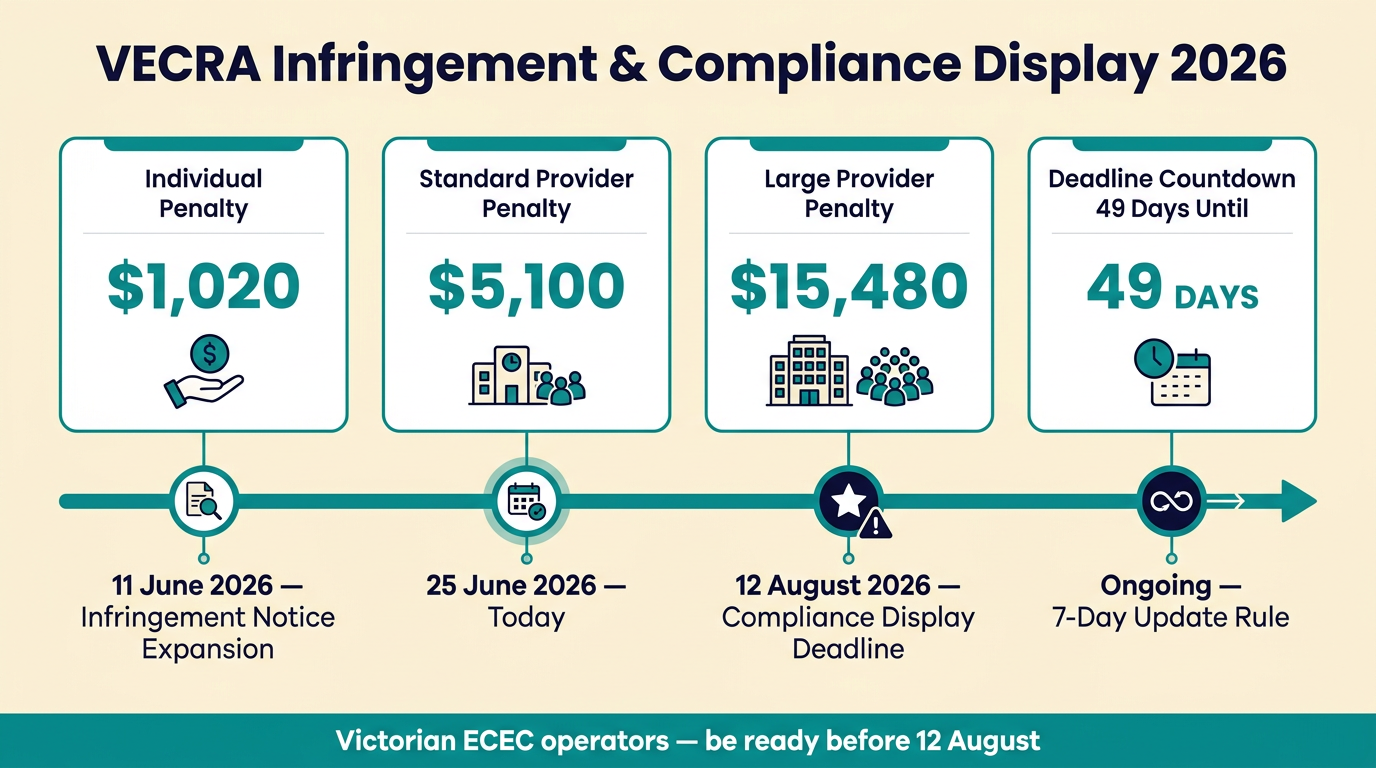
On 11 June 2026, Victoria's new regulator quietly gained the power to issue penalty infringement notices for additional provisions of the Education and Care Services National Law. The Victorian Early Childhood Regulatory Authority (VECRA) confirmed the expansion on its published reforms page the next day. Forty-nine days later, on 12 August 2026, every Victorian NQF service must begin displaying two years of compliance history at the front entrance — and VECRA can issue an infringement notice on the spot for failing to comply.
The two changes are operationally linked. The 12 August display obligation creates the visible compliance artefact that VECRA's expanded infringement powers now cover. A service with a compliance notice from the last two years that has not been displayed becomes an offence the regulator can fine in a single site visit — no prosecution, no internal review, no negotiation.
This guide walks through exactly what changed on 11 June, what the 12 August display obligation requires, the penalty amounts Victorian operators are now exposed to, and the 49-day operational plan to get a long day care, kindergarten, family day care or OSHC service ready before the deadline.
What changed on 11 June 2026
The 11 June 2026 amendment to Victoria's Early Childhood Legislation Amendment (Child Safety) Act 2025 gave VECRA the express power to impose infringement notices for additional provisions of the National Law and the National Regulations. VECRA'sChild safety reforms page, updated 12 June 2026, describes the change in a single sentence:
The significance is procedural, not substantive. Infringement notices are on-the-spot fines. The regulator issues them at a service visit, the operator pays or elects to have the matter heard in court, and the entire matter can be resolved without a prosecution file ever being opened. Before 11 June, VECRA's infringement powers covered a narrower band of administrative offences — primarily recordkeeping failures. After 11 June, the infringement net is wide enough to catch the new 12 August compliance display obligation, the National Early Childhood Worker Register notification failures, and the day-to-day policy and procedure offences that every operator already has on a checklist somewhere.
For a Victorian approved provider, the practical effect is that more breaches will be resolved with a fine rather than a prosecution. The Hall & Wilcox analysis of the 2026 child safety reforms (25 March 2026) describes the same dynamic nationally: "more administrative breaches (such as recordkeeping failures and missing quality improvement plans) can be dealt with by infringement notice. This streamlines the enforcement process for regulators as the requirement for certain substantive steps is removed."
What changes on 12 August 2026
From 12 August 2026, every approved provider operating a National Quality Framework service in Victoria must display aquality and compliance history at the service premises. The obligation applies to long day care, standalone kindergarten, family day care, Outside School Hours Care and vacation care. It does not apply to occasional care or limited hours services.
The display is not a marketing brochure. VECRA has prescribed exactly what must appear, in what order, using anApproved quality and compliance display template that the regulator publishes as a Word document on its website. The display must be visible from the main entrance. For family day care services, the display must appear at every residence, every venue, and the FDC office. Newly approved or transferred services display information from the approval date or transfer date.
Two pieces of information must appear.
1. Quality ratings history. The current overall quality rating, the most recent prior rating, and the date each was issued. This data is publicly available on StartingBlocks.gov.au — families can already see it; the change is that it must now be physically displayed at the service.
2. Compliance and prosecution history (2 years). The display must list every compliance action in the past two years against the approved provider, the nominated supervisor, or (for FDC) the educator. The eight categories VECRA requires you to publish are:
- Compliance notices
- Compliance directions
- Emergency action notices
- Infringement notices (to the approved provider or nominated supervisor)
- Enforceable undertakings (accepted from the approved provider or nominated supervisor)
- Amendments of the provider's provider approval
- Amendments of the service approval for the service
- Prohibition notices, directions to exclude a person, notices to suspend an FDC educator, and the emergency removal of a child or children
For each entry you must show the type of action, the provision of the National Law or National Regulations that resulted in the action (with a description), and the date the approved provider was notified. Prosecutions must show the offence committed, any sentence imposed, and the date of the finding of guilt. The display must remain accurate even while an action is under internal review — VECRA's position is that the decision "remains in place while the review is being conducted."
Any change to the compliance history must be reflected in the display within 7 days. That means the workflow behind the display is as important as the display itself: a notice issued on a Monday must be on the wall by the following Monday, or the operator is again exposed to an infringement notice.
The penalty amounts Victorian operators are now exposed to
The penalties for failing to comply with the 12 August 2026 display obligation are published in the VECRA infringement notice schedule. For the display obligation specifically, VECRA has set three penalty tiers:
- $1,020 for an individual (typically a nominated supervisor or person with management or control)
- $5,100 in any other case (a standard approved provider)
- $15,480 for a large childcare provider (typically an approved provider operating 25 or more services under the same approval)
Those are the on-the-spot infringement amounts — paid in full or disputed in court. They sit on top of the broader penalty regime that took effect on 2 January 2026 when maximum penalties under the National Law were tripled.
For context, here is what the rest of the 2026 penalty landscape looks like for a Victorian operator, all figures verified against the VECRA reforms page and the Hall & Wilcox sector analysis:
- Section 167 (protection of children from harm and hazards): up to $34,200 for an individual, up to $172,200 in any other case. Previously $11,400 and $57,400.
- Large Victorian providers (25 or more services): up to $1,034,100 for the most serious offences. Hall & Wilcox notes these "9x increases" apply to providers above the 25-service threshold.
- Mandatory reporting of sexual offences and misconduct (failure to notify VECRA): up to $13,500 for an individual, up to $68,700 in any other case, per contravention.
- Providing false or misleading information about a prohibition notice to a recruitment agency or approved provider: $20,400.
- Failure to notify the approved provider within 24 hours of a WWCC status change: $13,500.
The pattern across the schedule is the same: VECRA wants fewer prosecutions and more infringements. The infringement amounts are smaller than the maximum penalties for the same offence, but the process is faster, the paperwork is lighter, and the operator cannot delay enforcement by seeking an internal review without first paying.
The 49-day operational plan
Today (25 June 2026) leaves 49 days until the 12 August 2026 display obligation takes effect. For a single-service operator the work is manageable. For a 5-, 10- or 25-service group, the work compounds because each service needs its own accurate display. Here is the workflow we recommend.
Days 1 to 7 (25 June to 2 July): pull the data.
Each approved provider logs into NQA ITS and downloads the Compliance Summary Report from "My Provider" → "View provider reports" → "Compliance Summary." This report covers the past two years and lists the eight display categories. For services with no compliance history, the display still needs to be in place — the VECRA example template shows "Nil" with the current month, and that is a valid display. Cross-check the report against your own records: enforcement actions from VECRA that predate the NQA ITS system, prosecution outcomes, and any external complaints oracles.
Days 8 to 14 (3 July to 9 July): fill in the quality rating history.
Look up your service on StartingBlocks.gov.au. Record the current overall rating and the most recent prior rating, with the date each was issued. For services that have been approved or transferred within the last two years, record the relevant date instead. For services yet to be assessed and rated, record the provisional rating and the approval date.
Days 15 to 30 (10 July to 24 July): build the display.
Download the Approved quality and compliance display template from the VECRA website. The template is a 248 KB Word document; it is designed to be printed on a single A3 sheet (or two A4 sheets) and laminated if you want it to survive a high-traffic entrance. Fill in the compliance history table, the quality ratings table, and (if relevant) the prosecutions section. For family day care, prepare one display per residence, one per venue, and one for the office.
Days 31 to 45 (25 July to 7 August): install and verify.
Install the display so it is "clearly visible to anyone from the main entrance" (VECRA's language). For a centre-based service this usually means the parent-facing noticeboard or the entrance hallway. For FDC, the display goes at every venue. Photograph each installed display with a date-stamped camera — this is your evidence that the display was in place before 12 August. The same photo archive becomes your evidence trail if VECRA asks why a particular change did not appear within seven days of a new compliance action.
Days 46 to 49 (8 to 11 August): final review.
Re-download your Compliance Summary Report from NQA ITS and check that nothing has changed in the last 30 days. Walk each service and check that every display is still legible, still in place, and still accurate. Brief every nominated supervisor on the 7-day update rule and on who in your organisation is responsible for triggering an update when a new compliance action lands.
Why the workflow behind the display matters more than the display itself
VECRA's display obligation is not a one-off poster. It is an ongoing 7-day clock that starts every time a new compliance action is recorded against your provider approval. For a service that has had a clean compliance record for years, the display will look unchanged for long stretches and the temptation is to print it, laminate it, and forget about it. That is exactly the trap that will generate the first wave of infringement notices in late 2026.
The 7-day update rule creates a workflow requirement: someone in your organisation has to know, within 24 to 48 hours of VECRA issuing a compliance notice, that the notice exists and that the display needs to be amended. In practice that means three things need to be in place:
- A single source of truth for every compliance action against the provider approval — typically the NQA ITS Compliance Summary Report, refreshed weekly.
- A named owner who is responsible for triggering the display update — usually the service director or the compliance lead, not the centre manager.
- A documented update workflow with a 7-day SLA — preferably automated so the display change is triggered by the same system that records the underlying compliance action.
For operators still using spreadsheets or a shared inbox to track compliance actions, the 12 August deadline is a forcing function to move to a real compliance system. The cost of an infringement notice ($1,020 to $15,480) is recoverable. The reputational cost of a compliance notice being displayed in your front entrance for two years — visible to every parent who walks in — is not.
What this means for interstate operators
The 12 August 2026 display obligation is a Victorian requirement, not a national one. NSW, Queensland, South Australia, Western Australia, Tasmania, the ACT and the Northern Territory each regulate under their own state or territory authority. None of those authorities has published a comparable quality and compliance history display obligation, although ACECQA's broader transparency agenda is moving in the same direction.
For an interstate operator with no Victorian services, nothing changes on 12 August. For an interstate operator with Victorian services — or a national group with a Victorian acquisition in the pipeline — the 12 August obligation applies to every Victorian service in your portfolio, regardless of where head office sits. A single oversight in one Victorian service generates an infringement against the whole provider approval.
How NovoCove handles this
NovoCove was built for exactly this kind of regulatory transition. Every compliance notice, compliance direction, emergency action notice, infringement notice, enforceable undertaking, prohibition notice and emergency child removal that VECRA records against your provider approval is captured in the platform's compliance register as soon as it appears on the public register. The 7-day display update workflow is built into the system: a new entry automatically triggers a display amendment task with a 7-day SLA, the named owner is notified, and the date-stamped photo of the updated display is stored as evidence.
For multi-service operators, NovoCove generates one display per service from the same source data, so a single compliance action against the provider approval produces a display update for every affected Victorian service in parallel. For family day care operators, the platform generates a separate display for each residence, venue and the FDC office from the same underlying record. The display format mirrors the VECRA Approved quality and compliance display template, so what you print is what VECRA expects to see on the wall.
The 12 August 2026 deadline is 49 days away. If you are still tracking compliance actions in a spreadsheet, the fastest path to compliance is to move to a system that produces the VECRA display as a byproduct of recording the underlying compliance action. The 11 June 2026 infringement expansion means the cost of getting this wrong is now measured in fines — and the 7-day update rule means the cost of getting it right is an ongoing workflow commitment, not a one-off poster.
This guide is general information and is not legal advice.