Regulatory update
VECRA's First 90-Day Provider Suspension: What the Gabow Family Day Care Action Means for Every Approved ECEC Provider
Two new VECRA enforcement actions in 30 days have rewritten the risk profile for every approved Victorian ECEC provider. Here is the 6-step governance workflow that keeps you out of the same position as Gabow.
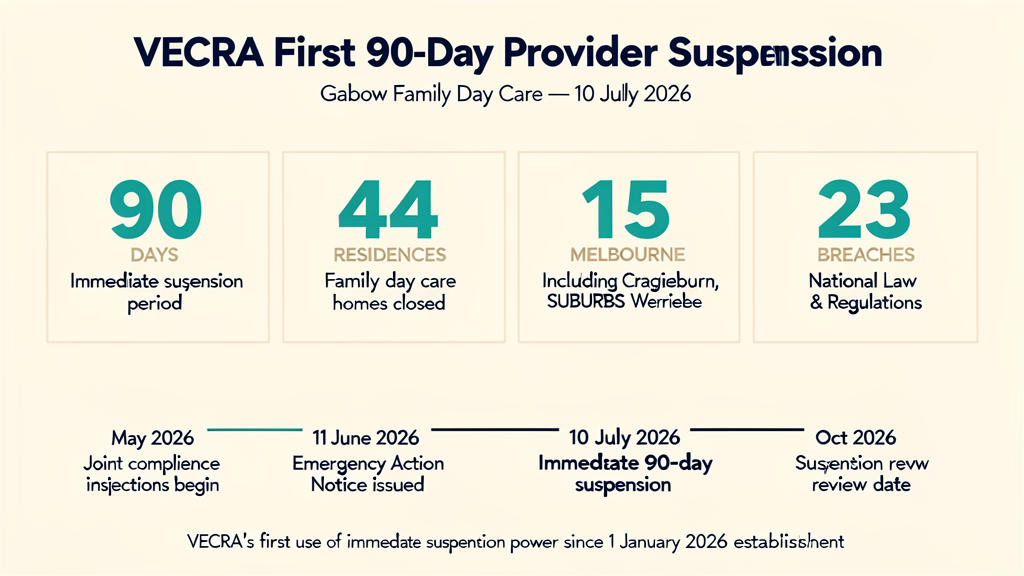
On Friday 10 July 2026, the Victorian Early Childhood Regulatory Authority (VECRA) did something it had never done before. It used its immediate suspension power to shut down an entire approved family day care provider for 90 days. The provider was Gabow Family Day Care Pty Ltd. The action forced the immediate closure of 44 family day care residences operating across 15 outer Melbourne suburbs, displaced every enrolled family and educator on those sites, and exposed what VECRA's interim regulator Wendy Steendam described as a "litany of compliance issues which created immediate risk to the safety of children."
The decision was published the same afternoon on the VECRA media release page, and it was the first time the new Victorian regulator had used the immediate suspension power since it became the state's independent early childhood regulator on 1 January 2026. The suspension is not a warning, not a notice, and not an enforceable undertaking. It is the most serious tool in VECRA's enforcement kit, and it was previously held in reserve while the agency built its inspection capacity and Joint Compliance and Monitoring Program partnership with the Australian Government Department of Education.
This guide walks through exactly what VECRA found, the timeline from the 11 June 2026 Emergency Action Notice to the 10 July 2026 immediate suspension, the 23 individual breaches VECRA relied on, the penalty exposure Gabow now carries, and the 6-step provider governance workflow every approved ECEC operator in Victoria and across the National Quality Framework needs to run before VECRA's next inspection.
What VECRA found at Gabow
The 10 July 2026 VECRA media release sets out the regulator's findings in plain language. Gabow Family Day Care held ultimate responsibility for compliance across 44 residences in suburbs including Hoppers Crossing, Epping, Lalor, Craigieburn, Mooroolbark and Werribee. VECRA found that across "many of the family day care premises" the provider had fallen short of National Law standards on educator qualifications and training, residence safety, fencing and furniture, storage of hazardous materials, transport authorisation, and the requirement to check and confirm that other adults residing in each educator home were suitable to be around children.
The 23 individual breaches VECRA identified after assessing the inspection evidence sat alongside an earlier finding from 11 June 2026 that four of Gabow's educators did not hold the required qualifications. Those four educators were already subject to an Emergency Action Notice requiring them to cease educating and caring for children until they were appropriately qualified. The 10 July decision escalated from individual educator non-compliance to whole-of-provider failure of governance.
The breadth of the breach categories is the most important signal in the media release. This was not a single failed compliance check or a paperwork error. VECRA's findings span at least seven distinct obligation families: educator qualifications, residence physical safety, furniture and equipment safety, hazardous materials storage, transport activity authorisation, WWCC-equivalent suitability checks for household residents, and the provider-level governance duty to maintain compliance across all residences. A provider who is failing across seven categories simultaneously is failing at the governance layer, not the site layer.
The 90-day immediate suspension timeline
The Gabow case did not arrive out of nowhere. VECRA's media release describes a multi-month trajectory from first inspection to suspension decision, and the timeline itself is instructive for every approved provider who wants to understand where the regulator's attention is concentrated.
- May 2026 — Joint Compliance and Monitoring Program inspections. VECRA's authorised officers conducted inspections of Gabow residences in partnership with the Australian Government Department of Education. The Joint Compliance and Monitoring Program was agreed by Education Ministers in August 2025 specifically to strengthen child safety and quality across both state and federal compliance dimensions. Inspections targeted risks to government funding and to quality and safety simultaneously.
- 11 June 2026 — Emergency Action Notice issued. VECRA served an Emergency Action Notice on Gabow after establishing that four of its educators did not hold the required qualifications. Those educators were required to cease educating and caring for children until appropriately qualified.
- Late June 2026 — Evidence assessment and further breach identification. After assessing all evidence and information collected from the May inspections, VECRA identified a further 23 breaches of the National Law and National Regulations. The breadth and severity of the breaches drove the decision to escalate from Emergency Action Notice to immediate suspension.
- 10 July 2026 — Immediate suspension for 90 days. VECRA determined that the number and wide range of failings meant it would not be in the best interests of children for the service to continue to operate. The approval was immediately suspended for 90 days, requiring Gabow to close all 44 residences and notify every enrolled family.
The four-step arc — joint inspection, Emergency Action Notice for a subset of sites, evidence assessment identifying broader provider-level failure, then immediate suspension of the whole approval — is the operating pattern VECRA has now demonstrated it will use. Any approved provider in Victoria is one Joint Compliance inspection away from the same sequence.
What "immediate suspension" actually means
A 90-day immediate suspension under the National Law is not the same as a cancellation, an infringement notice, or a prosecution. It is a separate, urgent enforcement tool that allows the regulator to shut down operations while the provider works to demonstrate compliance. The provider does not lose its approval permanently — it loses the ability to operate for the suspension period, and it must satisfy VECRA that every breach has been rectified before the suspension ends.
For the families and educators at Gabow's 44 residences, the practical effect is immediate and severe. Gabow has been directed to provide written notice to every parent and carer advising that the service will no longer be able to provide education and care during the suspension period. Educators at those residences are displaced from their income. The provider's revenue stream from Child Care Subsidy payments is cut to zero for the affected residences for 90 days. And the longer-term risk is that if Gabow cannot demonstrate rectification by the end of the suspension, VECRA can extend the suspension or escalate to cancellation.
The 23 breaches: what every approved provider can learn
VECRA's media release does not enumerate all 23 breaches individually, but it does name the obligation families. For every approved provider in Victoria, these categories are the must-have checklist items. A provider who can demonstrate evidence-backed compliance in each of these seven areas is in a strong position when VECRA's joint inspectors arrive.
- Educator qualifications and training currency. Every educator delivering education and care must hold the required qualifications and remain current. VECRA's 11 June finding that four Gabow educators were unqualified is the highest-stakes single compliance failure because it is an immediate Section 167 risk to children.
- Residence physical safety. Family day care residences must be safe for children. Fencing, gates, pool barriers, balcony and stair safety, electrical safety, and the absence of structural hazards are baseline requirements. Inspections go room by room.
- Furniture and equipment safety. Heavy furniture must be anchored. Trampolines must have safety matting. Chest freezers must have child safety locks. The earlier April 2026 VECRA Emergency Action Notice against a different FDC provider identified unsecured bookshelves, chest freezers without locks, and trampolines without matting as specific Section 167 hazards. These patterns recur.
- Hazardous materials storage. Bleach, paint, rat poison, cleaning products, and any other hazardous chemicals must be inaccessible to children. The earlier VECRA case found bleach and rat bait accessible in multiple rooms.
- Transport activity authorisation. Any transport of children by the provider or its educators — excursions, pickup and drop-off, off-site activities — must be properly authorised, documented and supervised.
- Suitability checks for household residents. Other adults living in a family day care educator's residence must be checked and confirmed suitable to be around children. This is the WWCC-equivalent layer for FDC and is a common audit failure.
- Provider-level governance. The approved provider must maintain oversight, monitoring, coaching and quality assurance systems that detect compliance drift across every linked residence. Failure in this category is what converts individual site problems into immediate suspension of the whole approval.
What happens after the 90 days
VECRA has set Gabow a hard 90-day window to rectify every breach and demonstrate compliance to the regulator's satisfaction. If Gabow can do that, the suspension lifts and operations can resume at the 44 residences — subject to whatever additional conditions VECRA chooses to impose. If Gabow cannot demonstrate rectification by the end of the 90 days, VECRA can extend the suspension or escalate to a full cancellation of approval, which would terminate Gabow's Child Care Subsidy eligibility permanently.
Beyond the immediate Gabow case, the 10 July action sets a precedent for how VECRA will use the immediate suspension power going forward. The regulator has now demonstrated four things in a single decision: it can run joint inspections with the federal Department of Education, escalate from Emergency Action Notice to immediate suspension within 30 days, identify more than 20 distinct breaches from a single inspection cycle, and shut down an entire provider across dozens of residences in a single decision. Any approved provider in Victoria is now operating against a known baseline: VECRA's first use of the suspension power has set the bar at "multiple breaches across multiple obligation families".
The 6-step governance workflow for every approved provider
The Gabow case shows that VECRA's enforcement priority sits at the provider governance layer. A single non-compliant residence can trigger an Emergency Action Notice. Multiple non-compliant residences plus governance failures trigger an immediate suspension. Every approved provider needs a workflow that surfaces residence-level compliance problems to the governance layer before the regulator does.
- Run unannounced home visits on a quarterly cycle at minimum. VECRA's Joint Compliance inspections are unannounced. Your internal cycle should match. An announced annual visit will not catch the chemicals left on the kitchen bench the week before.
- Maintain a daily safety checklist for every FDC residence. Educators should complete and submit a daily checklist covering hazardous materials storage, furniture anchoring, gate and fence integrity, pool barriers, and any changes to household occupants. A digital checklist with timestamped submission is the right format.
- Verify educator qualifications on a 30-day rolling cycle. Qualifications lapse. WWCCs expire. First aid certificates age out. A 30-day rolling cycle catches expirations before they become Section 167 risks. The 11 June Emergency Action Notice against Gabow started with four educators found unqualified — that should never have reached the inspection stage.
- Document transport activities with parent authorisation on file before every excursion. Transport authorisation is one of the seven breach categories VECRA identified. A documented authorisation record, signed by parents before the activity, with educator sign-on and sign-off, is the minimum evidence pack.
- Maintain a household occupant register for every FDC residence. Every adult residing at an educator's home must be checked and confirmed suitable. New occupants, visiting relatives, adult children returning home — each triggers a fresh check. The register is the document VECRA will ask for first.
- Hold a monthly governance review with the executive team. The provider must demonstrate oversight. A monthly review of every residence's compliance posture, every educator's qualification status, and every open incident or complaint is the governance evidence the regulator expects. If the regulator asks the CEO "how do you know your residences are compliant", the answer must be a documented process, not a feeling.
How NovoCove helps you stay ahead of the suspension bar
The Gabow suspension is exactly the kind of enforcement event that compliance management software is designed to prevent. The seven breach categories VECRA identified are all compliance artefacts that NovoCove tracks as structured data points, with daily freshness, automated expiry alerts, and a governance review dashboard that surfaces provider-wide risk before the regulator arrives.
NovoCove maintains a real-time record of every educator's qualifications, WWCC status, first aid certification, and child protection training completion, with seven-tier expiry alerts fired well before any certificate lapses. For family day care operators, NovoCove runs a residence compliance profile per site — hazardous materials register, furniture anchoring log, fence and gate integrity checklist, pool barrier certification, transport authorisation records, and a household occupant register with WWCC-equivalent verification status for every adult resident.
The monthly governance review sits on top of all of this. The CEO and the responsible person can pull a single dashboard view of compliance posture across every linked residence, see every open incident, every expired certificate, and every outstanding household occupant check, and act on it before VECRA's joint inspectors do. When the regulator asks for evidence, the evidence is already in the system — dated, timestamped, and exportable.
This guide is general information and is not legal advice.