Aged care compliance
Support at Home Personal Care is Now Free: What the 1 October 2026 Zero-Contribution Change Means for Your Provider
From 1 October 2026, every approved personal care service under Support at Home is fully government funded. Here is what is changing, what is not, and the 90-day operational checklist that keeps your billing, statements, and pricing compliance clean under the new ACQSC monitoring regime.
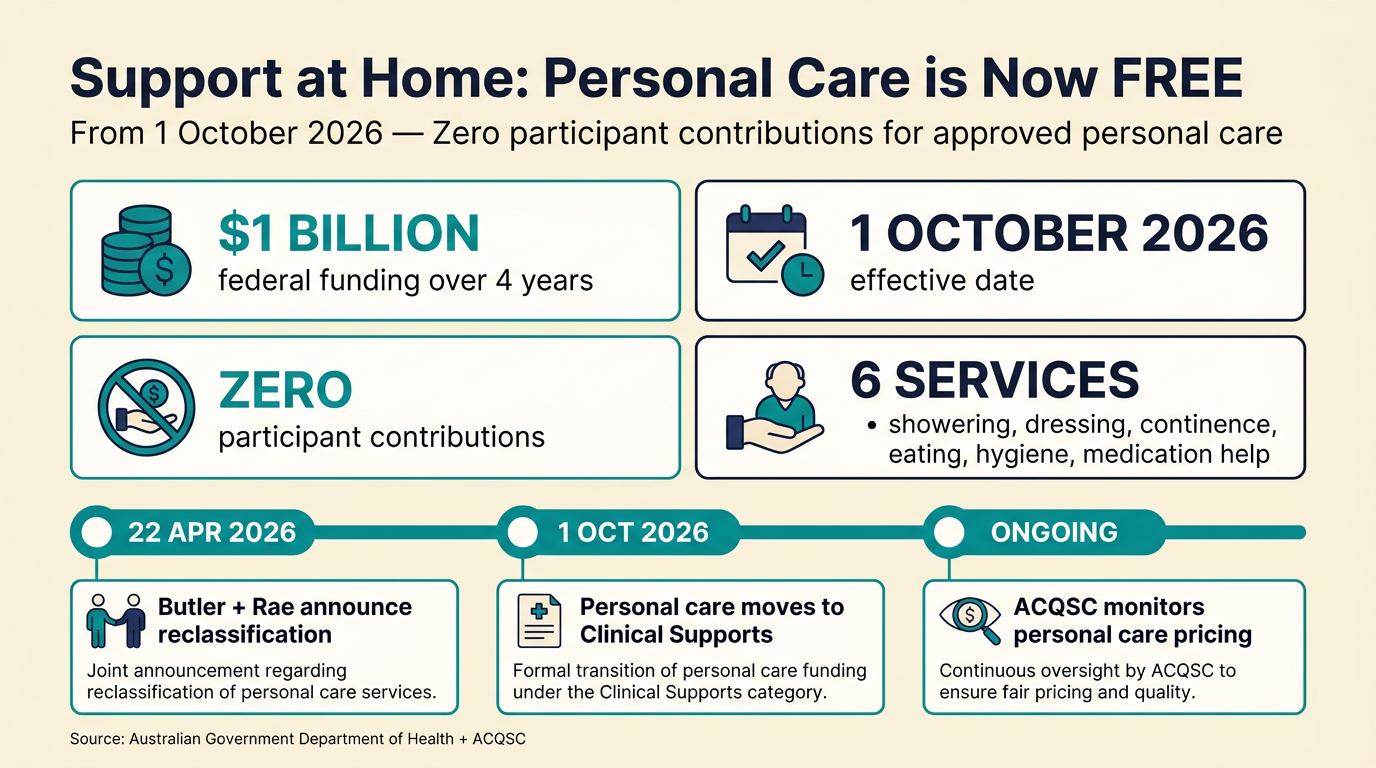
On 1 October 2026, the bill that an older Australian sees for help with showering, dressing or continence care goes to zero. Not a discount. Not a cap. Zero. The Australian Government is reclassifying personal care under the Support at Home program from the Independence contribution category to the fully funded Clinical Supports category, and the $1 billion cost of the change over four years is being met out of consolidated revenue rather than participant pockets. For a Support at Home provider, that single line in the May 2026 Federal Budget has more moving parts than any other compliance change on your 2026 roadmap: every invoice template, every monthly statement, every service agreement, every individualised budget, and every hourly rate card needs a documented review before the new category goes live.
What is actually changing on 1 October 2026
The change is mandatory for every registered Support at Home provider delivering personal care services. From 1 October 2026, those services move from the Independence contributions category to the Clinical Supports contributions category. Clinical Supports are fully government funded. Approved personal care services delivered from 1 October onward will have a participant contribution of zero, provided two conditions are met: the personal care is approved and recorded in the participant's current support plan, and the participant has available funding in their Support at Home budget.
The Health and Aged Care Ministers confirmed the move on 22 April 2026, with the reclassification priced at $1 billion over four years and locked into the 2026-27 Federal Budget as part of a $3 billion package supporting older Australians. From the participant's perspective, the change is invisible in the best possible way — the invoice just stops showing a personal care line. From the provider's perspective, it is the most consequential billing event since Support at Home replaced the Home Care Packages program on 1 November 2025.
Three operational details matter most:
- Pre-1 October claims still attract a contribution. If a personal care service is delivered on 30 September 2026 and invoiced on 5 October 2026, the participant contribution that applied on 30 September still applies. Only services actually delivered on or after 1 October 2026 are fully funded. Service date, not invoice date, is the trigger.
- Service IDs and registration categories are unchanged. The Service list on My Aged Care is not being amended. Personal care keeps its current classification, its current service IDs, and its current worker qualification requirements. The only thing changing is the contribution category used for billing and reporting purposes.
- The change is mandatory, not optional. Providers cannot continue to charge a contribution for approved personal care delivered on or after 1 October 2026. Doing so creates a participant refund obligation and a likely compliance contact from the Aged Care Quality and Safety Commission.
Which services are now fully funded
The list of personal care services has not changed. Six task types have always been classified as personal care under the Support at Home service list, and all six are now fully funded from 1 October 2026:
- Showering and bathing — assistance with full-body or part-body washing, including bed baths where the consumer is not mobile.
- Dressing and undressing — assistance with putting on or removing clothing, including compression stockings and orthotic aids.
- Continence support and toileting assistance — assistance with toileting, continence aid changes, and catheter or stoma bag management where the task is non-clinical.
- Eating assistance — help with feeding where the consumer can swallow safely but cannot physically manage utensils or plates unassisted.
- Personal hygiene — grooming tasks including oral care, hair care, nail care, and skin care.
- Help with self-administration of daily medication — prompting, opening containers, and reading labels. Does not include clinical medication administration, which remains a clinical care task.
Two services that providers sometimes classify as personal care are deliberately not in scope of the zero-contribution change:
- Domestic assistance (cleaning, laundry, meal preparation) remains in the Independence category. The participant contribution model is unchanged for these services.
- Clinical nursing care (wound care, catheter care, medication administration) was already a fully funded Clinical Supports category service. No change.
If you are uncertain whether a specific task your team delivers is personal care, default to the My Aged Care Service list. The classification has not been redrawn — only the contribution category used to bill personal care has moved.
Why the government made the change
The reclassification is the direct response to months of evidence that the original November 2025 fee structure was pricing older Australians out of the personal care they were assessed as needing. Under the Independence category, participants paid means-tested co-contributions ranging from approximately 5 per cent of the service price for full pensioners up to 50 per cent for self-funded retirees. By April 2026, the Inspector-General of Aged Care, Natalie Siegel-Brown, had publicly warned that the co-payments were discriminating against those on the lowest incomes and raised human rights concerns about the impact on functional independence.
The clinical case was equally clear. Reports emerged of older Australians skipping showers, reducing care visits, or declining assistance with continence management because they could not afford the contribution. Hundreds of federal politicians signed an open letter opposing the charges. In announcing the change, Aged Care Minister Sam Rae acknowledged on ABC News Breakfast that the government had listened directly to older people and their families, and that the sector view — that showering, dressing and continence management are clinical care, not lifestyle services — had prevailed.
The policy framing matters for providers because it explains why the change is paired with new ACQSC pricing scrutiny. The government has removed a revenue source from providers (the participant contribution) and replaced it with full government funding. The implicit deal is that providers will not adjust their hourly rates upwards to recoup the lost contribution. ACQSC is the entity charged with making sure the deal holds.
What providers must update before 1 October
The Department of Health and Aged Care's 28 May 2026 provider information session outlined five operational areas that must be updated before the 1 October 2026 transition. None of them is optional, and the Department has been clear that the expectation is a seamless transition with no participant asked to pay a contribution for a service delivered on or after 1 October.
- ICT systems and service setup. Your rostering, billing, claiming, and reporting system needs a new contribution category mapped to personal care service IDs. Most major aged care software platforms have flagged the change in their 2026 release notes; smaller in-house systems will need a manual config update and end-to-end test before 30 September 2026.
- Service agreements and individualised budgets. Every active participant's service agreement and individualised budget needs an update reflecting the zero contribution for personal care from 1 October. The agreement should explicitly retain the participant's total quarterly budget but allocate more of it to the now-zero-cost personal care line and less to the participant's out-of-pocket exposure.
- Monthly statements and invoices. October statements must show personal care as a fully funded line with no contribution amount and no contribution rate. Pre-1 October service lines on the same statement must continue to show the applicable contribution. This is the single most visible test of whether your transition is working — the first October statement a participant receives tells them instantly whether the change has been applied.
- Care plans and clinical documentation. Care plans do not need a wholesale rewrite, but personal care goals and tasks need to be re-tagged with the new contribution category. If your care plan template has a 'participant contribution' field for personal care tasks, that field needs to read zero from 1 October onward.
- Communications and frontline scripts. Personal care workers, care managers, intake staff, and billing staff all need a one-page summary of the change and a script for the most common participant questions: 'When does it start?' (1 October 2026, by service date), 'What about services I had in September?' (still charged the old contribution), 'Will my package budget go further?' (yes, because the personal care line no longer draws down their available funding).
The ACQSC pricing scrutiny regime
The most significant non-billing change in the package is the new ACQSC pricing scrutiny regime, which was confirmed on 19 May 2026 alongside the indefinite deferral of the Support at Home price caps that had originally been scheduled for 1 July 2026. The price caps have been shelved, but the consumer protection machinery around pricing has been strengthened:
- Refund powers for overcharging. ACQSC can now order a provider to refund participant contributions where it identifies overcharging. This applies across all Support at Home services, not just personal care, but the personal care transition is the explicit use case the government has cited.
- Monthly statement enforcement. ACQSC can take regulatory action against providers who fail to issue monthly statements. The expectation is that every Support at Home participant receives a clear monthly statement showing services delivered, hours, unit price, and any applicable contribution. Personal care transition is a likely focus of statement-quality audits in October-November 2026.
- Quarterly national pricing summary. A new National Summary of Support at Home Prices will be published quarterly, showing the median and range of prices charged by providers for each service type. The first summary is expected in late 2026, and personal care pricing will be a featured category given the contribution change.
- Specific monitoring of personal care pricing. The Department of Health and ACQSC have committed to specifically monitoring personal care prices as the service type transitions into Clinical Supports. The stated objective is to ensure providers are not adjusting their hourly rates to recoup the removed participant contribution.
- Twice-yearly price increase norm. Providers are being encouraged to cap the frequency of price increases at twice annually, so that older people can plan and budget their packages with greater confidence. While not mandatory, a provider that increases personal care rates in the 60 days after 1 October will draw immediate attention from the quarterly pricing summary.
In short, the 1 October 2026 transition is not a 'set and forget' billing update. It is the first 12 weeks of a new ACQSC monitoring regime in which personal care pricing is the test case. Providers that handle the transition cleanly will find the quarterly pricing summary treats them as benchmark providers. Providers that adjust rates upwards to recover the lost contribution will find their pricing flagged.
The 90-day operational checklist
The Department of Health and ACQSC have both indicated that they expect a seamless transition for participants. The providers who will be most exposed at audit are those who treat this as a billing update alone. The providers who will pass cleanly are those who treat it as an end-to-end operating model change. The 90-day checklist below covers the work that should be done in the 13 weeks between now and 1 October 2026.
Days 1 to 30 — systems and configuration.
- Map every personal care service ID to the new Clinical Supports contribution category in your rostering and billing system.
- Run a parallel billing test on a 50-participant sample for the September-to-October transition, comparing old and new contribution treatment by service date.
- Update your service agreement template to reflect the zero-contribution language for personal care from 1 October, with explicit grandfathering for pre-1 October service dates.
- Issue a written change-of-terms notice to every active participant at least 30 days before 1 October, in line with your service agreement variation clause.
Days 31 to 60 — documentation and statements.
- Update your monthly statement template to clearly show personal care as a fully funded line with zero contribution from 1 October, while pre-1 October service lines retain their contribution treatment.
- Re-tag every active care plan with the new contribution category for personal care tasks. Most care management systems will need a bulk update tool or a SQL script.
- Draft a one-page participant FAQ and a one-page frontline worker script covering the most common questions: when does it start, what about September, does my budget go further.
- Brief every personal care worker, care manager, intake coordinator, and billing officer on the change, the FAQ, and the script. Document the briefing for ACQSC evidence.
Days 61 to 90 — pricing posture and audit readiness.
- Hold a formal pricing review meeting and document the decision not to increase personal care rates in the October-to-December 2026 quarter to recoup the removed contribution. The minutes become your best evidence at audit.
- Lock your personal care hourly rate through to at least 31 March 2027, and document the rationale. ACQSC has signalled that twice-yearly price increases is the expected norm.
- Prepare a transition evidence pack: the original announcement, your service agreement update, your statement template change, your participant communications, your frontline briefing records, and your pricing review minutes.
- Run a mock first-month audit. Pull your first 20 October statements and check that every personal care line shows zero contribution, every pre-October service shows the correct contribution, and every participant has received a clear written communication.
How NovoCove handles this
The 1 October 2026 personal care reclassification is exactly the kind of regulatory change that NovoCove was built to operationalise. Every Support at Home provider we work with manages a portfolio of compliance obligations — SIRS notifications, ACQSC registration, monthly statement obligations, pricing transparency — and the personal care transition touches all of them at once. The risk is not knowing the rule; the risk is leaving the system updates to the last two weeks of September and hoping the billing engine catches up.
NovoCove's aged care compliance workflows let you map the personal care reclassification to a structured change programme: a billing and systems change tracked to a named owner and a hard deadline, a service agreement template update version-controlled and distributed, a participant communications log with delivery and read receipts, a frontline briefing register with attendance records, and a pricing review minute file with sign-off. When the first ACQSC contact lands, you have a single folder with the evidence the Commission expects, and you can demonstrate that the transition was treated as a compliance programme rather than a billing tweak.
The same workflow also catches the second-order risks: a personal care worker who delivers a service on 30 September 2026 and is not re-briefed on the new contribution category, a care plan that retains the old contribution field, a monthly statement that shows a participant still being charged. Each of these is the kind of issue ACQSC has explicitly said it will pursue under its expanded refund and enforcement powers. NovoCove gives you the workflow to find and close them before ACQSC does.
This guide is general information and is not legal advice.