Regulatory update
NQF Annual Licence Fees Are Up to 11x Higher from 1 July 2026: What Every NSW and Victorian Childcare Operator Needs to Know
On 20 February 2026 Education Ministers agreed to unprecedented annual licence fee hikes under the National Quality Framework. From 1 July 2026, large for-profit NSW and Victorian providers face an 11-fold increase on top of CPI. Small operators see 3x to 5x. Tasmania, SA and ACT see a flat 10 per cent rise. QLD, WA and NT are not affected. Here is what the decision means dollar-for-dollar, which services are in scope, and how to make sure your first quarterly licence invoice lands without a surprise.
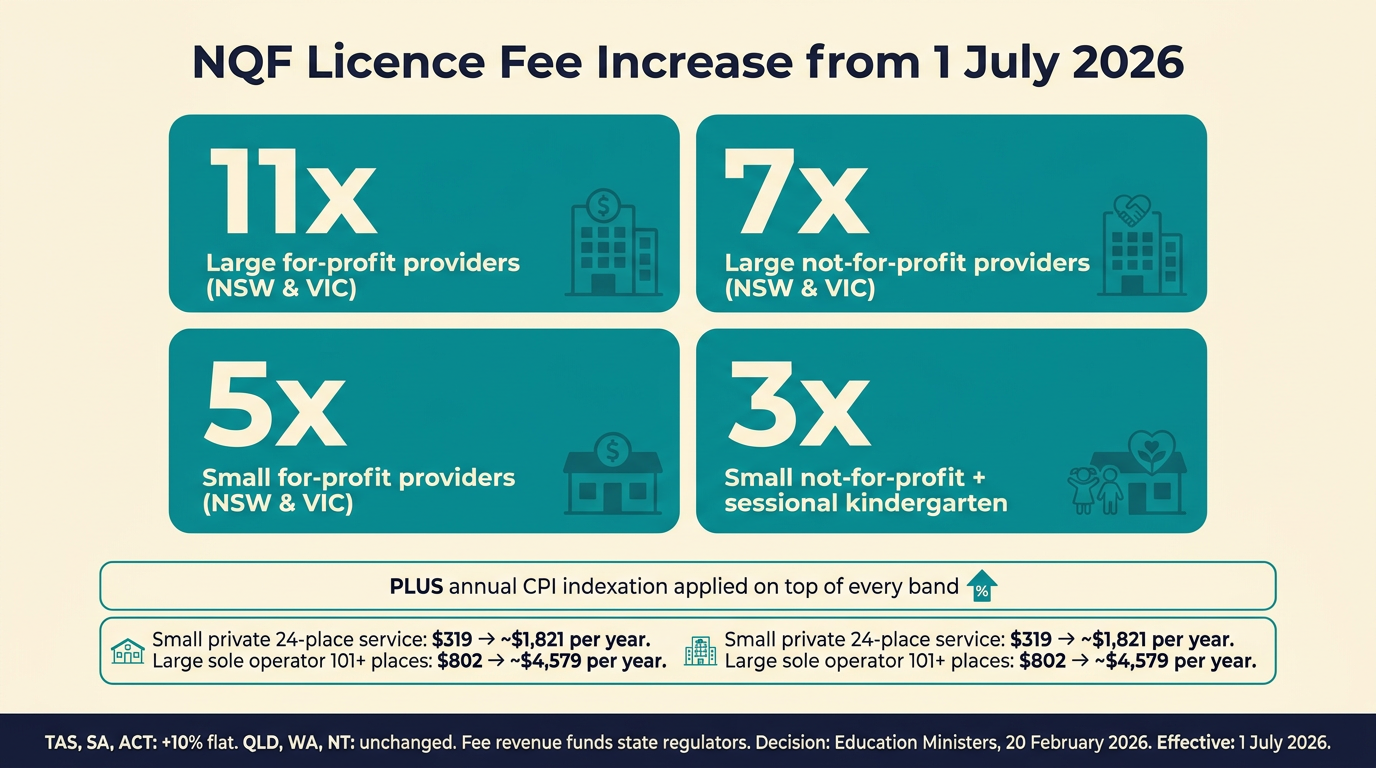
On 20 February 2026, the Education Ministers who sit around the table of the Council of Australian Governments walked into a meeting in Canberra with the routine item of NQF fee indexation on the agenda and walked out having agreed to the largest annual increase to National Quality Framework licence fees in the framework's fifteen-year history. From 1 July 2026, the annual fee that every Australian long day care, kindergarten, family day care, outside school hours care and vacation care service pays to fund regulatory oversight will rise by up to eleven-fold in New South Wales and Victoria, by ten per cent across every service type in Tasmania, South Australia and the ACT, and not at all in Queensland, Western Australia or the Northern Territory. For a small, owner-operated 24-place private centre in Sydney or Melbourne, the annual fee is moving from roughly $319 to about $1,821. For a sole-operator service running more than 101 places, the number moves from around $802 to approximately $4,579, before any CPI indexation on top.
The headline figure that has dominated sector coverage — "up to 1000 per cent" — is accurate as a worst-case multiplier for a large for-profit provider in NSW or Victoria, but it obscures the more important operational story. The fee increase is scaled, structured, and implements on 1 July 2026, which gives operators around 130 days to model the impact, communicate it to their board, fold it into their 2026-27 budget, and have the documentation ready for the new annual invoice. This guide walks through the dollar figures, the size categories, the four-jurisdiction split, and the workflow that turns this from a surprise into a documented line item.
The decision, the dollar figures, and the four-jurisdiction split
The fee increase was agreed at the Education Ministers meeting on 20 February 2026 and announced publicly in March 2026 by the Victorian Government and ACECQA. Education Ministers were explicit that the new revenue will be paid directly to the state and territory regulatory authorities to fund the cost of a strengthened regime. That means the fee is not going into general consolidated revenue — it is being hypothecated to fund the regulator capacity that recent child safety reviews recommended. The Australian Childcare Alliance responded on 24 February 2026 with a media statement warning that the increases will fall hardest on the small, independent, owner-operated services that make up the majority of the sector, and are explicitly on top of the CPI indexation that already applies every 1 July.
The decision splits Australia cleanly into four jurisdictional tiers:
- New South Wales and Victoria — the 11x / 7x / 5x / 3x tier. All five categories of ECEC service (centre-based, kindergarten, family day care, outside school hours care, vacation care) face a scaled increase that varies by service size, provider size, and whether the approved provider is for-profit or not-for-profit. On top of that increase, the standard CPI indexation applies.
- Tasmania, South Australia and the Australian Capital Territory — the flat 10 per cent tier. Every service type receives a single 10 per cent annual fee increase, regardless of size or provider type. CPI still applies on top.
- Queensland, Western Australia and the Northern Territory — unchanged. The decision does not apply. Existing CPI indexation continues, but no structural increase has been agreed at this round.
- Commonwealth funding for sector reform. Education Ministers also confirmed additional Commonwealth funding to support regulatory readiness, but the fee revenue stays with the state and territory regulators — it does not flow back to providers.
The compounding effect matters. A service that was already paying CPI-indexed fees now pays CPI-plus. The 10 per cent Tasmania, SA and ACT increase is on top of CPI. The 11x NSW and Victorian increase is on top of CPI. Even services that have grown accustomed to assuming that the annual NQF fee rises roughly in line with inflation will see their line item more than double, more than quadruple, or more than tenfold in NSW and Victoria depending on which category they fall into.
Which services fall into which scale: the size and provider categories
The Victoria Department of Education and Training confirmed the size matrix in March 2026. Centre-based and family day care services are sized differently, and the multiplier applied to the new annual fee depends on which size band your service falls into, AND which provider size band your approved provider falls into. The decision is binary at each band boundary, so the practical step one for every operator is to confirm both classifications against your current NQF approval certificate before 1 July 2026.
For centre-based services — long day care, kindergarten, outside school hours care and vacation care:
- Small: 24 or fewer approved places.
- Medium: 25 to 80 approved places.
- Large: 81 to 100 approved places.
- Extra-large: 101 or more approved places.
For family day care services:
- Small: five or fewer registered educators.
- Medium: six to twenty registered educators.
- Large: twenty-one to sixty registered educators.
- Extra-large: sixty-one or more registered educators.
For approved providers — the entity that holds the approval under the National Law — the scale is simpler:
- Small provider: fewer than 25 services under that approved provider number.
- Large provider: 25 or more services under that approved provider number.
The multiplier then applies. Sessional kindergarten services and any service run by a small not-for-profit provider receive a 3.3-fold increase. Services run by a large not-for-profit provider receive a 7.7-fold increase, except sessional kindergartens run by large not-for-profits which remain at the 3.3-fold increase. Services run by a small for-profit provider receive a 5.5-fold increase. Services run by a large for-profit provider receive an 11-fold increase. CPI applies on top of every figure in every band.
The reason the for-profit / not-for-profit split matters so much is that around 70 per cent of Australian ECEC services are operated by small, independent for-profit operators — the classic mum-and-dad owner-operator, often with a single service or a small portfolio of two to five centres. Under the new scale, those services fall into either the small for-profit 5.5x or the small not-for-profit 3.3x band. A multi-site for-profit group running 25 or more services falls into the 11x band.
Why the ministers made the change
The decision reads as a political response to the rapid succession of child safety failures that dominated ECEC sector coverage through late 2025 and early 2026. The Victorian Government had already announced $137 million in additional sector funding as part of its response to the Rapid Child Safety Review and established the Victorian Early Childhood Regulatory Authority on 1 January 2026 to take over regulatory functions from the Department of Education and Training. VECRA gained expanded infringement powers in June 2026 (see our earlier post on the VECRA infringement notices and 12 August compliance display). The NSW Government is making parallel structural changes. The fee increase is the revenue mechanism that pays for the regulator capacity that those structural reforms require.
ACECQA's role is unchanged: ACECQA remains the national regulator that publishes the fee schedule, holds the framework, and administers the Working with Children Check national mutual recognition work. State and territory regulators (VECRA in Victoria, the NSW ECEC Regulator, QFCC in Queensland, the Education Standards Board in South Australia, and so on) receive the new revenue and run the compliance visits, assessment and rating visits, and incident response work that the framework requires. The federal-regulator / state-regulator split is preserved; the new fees just give the state regulators more money to do the work.
For providers this means the increase is unlikely to be revisited in the short term. The federal-state funding arrangement is structurally aligned with the child safety reform agenda, and the revenue is committed to specific regulatory capacity. Any sector pushback on the headline figure is unlikely to change the 1 July 2026 effective date. The window for action is financial and operational, not political.
What you need to do between now and 1 July 2026
The decision date is 20 February 2026. The effective date is 1 July 2026. The first invoice under the new schedule will arrive in the third quarter of the calendar year, and the 2026-27 financial year for accounting and budget purposes starts on the same day. Four operational actions cover most of the ground:
- Confirm your size band, formally. Pull your current NQF approval certificate and confirm both your service size band and your provider size band. Document the date you confirmed it and the source document. If you are within one service of crossing the 25-service large-provider threshold, model the impact at both tiers and decide explicitly which side to land on.
- Model the 2026-27 budget against the new fee schedule. Build the annual fee as a known line item with the CPI adjustment on top, and book the difference against the same income line every quarter so that variance reporting is clean. For a small private centre moving from $319 to $1,821 pre-CPI, the 12-month impact is a minimum of $1,500 of new cost. For a large for-profit sole operator, the 12-month impact is around $3,800 pre-CPI. These are not large numbers in isolation; they become large numbers when multiplied across a portfolio.
- Update your financial assurance model. The Childcare Subsidy financial assurance framework already requires a margin of at least a few per cent. A doubled or tripled annual fee is one line item to be absorbed in a sector already feeling the weight of the WRP fee cap, the National Worker Register rollout cost, the excursion compliance uplift, and rising WorkCover. The combination is real for small operators — model it now, not at year-end.
- Document the decision and the source. Keep a copy of the ACECQA indexed fees page, the relevant state regulator announcement, and the Education Ministers communique on file. When your board or your auditor asks why a specific line item rose by a specific amount, you need the source.
For Tasmanian, SA and ACT operators, the operational lift is much smaller. The 10 per cent increase is on top of CPI but does not change the structural category of the fee. The action is to update the budget line, confirm the new dollar figure against the ACECQA published schedule, and document it.
How NovoCove handles this
NovoCove's financial and compliance dashboard tracks changing NQF fee schedules by jurisdiction, by service size band, and by provider size band, so the new $1,821 or $4,579 figure appears as an updated line item on every financial model that touches an NSW or Victorian service. The platform also flags the 25-service provider-size boundary so an upcoming expansion is modelled against both the current band and the next band, and the change is visible to the board before approval.
For multi-site operators — the large for-profit tier that faces the 11x increase — NovoCove aggregates the annual fee across the portfolio, models the consolidated CPI uplift, and runs sensitivity on what a 5 per cent margin compression does to the combined rebate-eligible hours under the CCS scheme. For small single-service operators in the 5.5x tier, the platform keeps the annual fee as a documented line in the operational budget alongside WRP fee-cap tracking, excursion risk assessments, the National Early Childhood Worker Register, child safety training completion, and the rest of the 2026-27 compliance load. The fee change is one item in a long list of changes this year — the workflow that keeps the list current is the single biggest compliance uplift an operator can make.
The 1 July 2026 licence fee increase is not the largest fee or the most complex change on the 2026-07 compliance calendar, but it is the most uniformly across-the-board, and it lands on the same day that the WRP fee cap moves to 5.8 per cent, the National Early Childhood Worker Register reaches its first compliance milestone, and the new national child safety training Foundation deadline of 27 August 2026 is eight weeks away. Operators that run a single quarterly review across all four changes will land the year well ahead of those that address each change in isolation.
This guide is general information and is not legal advice.